 Laneo
Book a call →
Laneo
Book a call →
Laneo
Book a call →
Laneo
Book a call →
Commissioning candidate · activation gates remain
● Residential contractors — Contractor Revenue InfrastructureA follow-through operating system for residential contractors: every enquiry becomes visible work with an owner, every quote needs approval before it sends, and every open opportunity carries a next action. Designed, built, and tested against strict evidence rules — client outcomes not yet measured.

Workflows installed — inquiry recovery, quote owner review, booking sync, guarded quote follow-up, and the weekday Revenue Recovery List.
Opportunities in the capacity envelope — the standard pipeline the system is configured to carry.
Local regression tests passed — the frozen source tree behaves as specified, locally (Oct 1).
Canonical project per job — reschedules and updates patch the same record; nothing silently duplicates.
Every quote waits for owner sign-off — bound to the exact version reviewed before it sends.
Every enquiry becomes owned work — an assigned human, a due date, and a recorded next action.
Illustrative model — not a measured client result.
Jobs won — illustrative scenario.
Total won job value — 2 jobs at an explicit US$2,000 value per job.
Follow-up time — estimated manual effort potentially removed in the month.
At an assumed US$40/hour, roughly US$267 of modelled labour capacity. Actual cash savings: not measured.
| Industry | Residential contractors — renovation, electrical, and plumbing profiles |
| Stack | HighLevel · n8n · Supabase — installed around the contractor’s existing accounts |
| Operating need | Every enquiry, estimate, and quote stays visibly owned with a recorded next action — without ripping out the tools already in place |
A contractor can already have a website, referrals, a calendar, and a job-management tool — and still lose jobs between first contact and a decision. The failure is usually not a lack of software. It is a lack of clear ownership, a recorded next step, consistent follow-through, and reliable stop conditions across the tools they already use.
Contractor Follow-Through System (CFS) keeps existing enquiries, estimates, and quotes moving toward an explicit decision. The optional Contractor Demand Engine (CDE) captures and routes new enquiries upstream and hands verified opportunities to CFS. A shared deployment factory packages both for configuration-led installation — no per-client source forks.
The system may read, prepare, recommend, and classify deterministic states. Only specifically authorised paths may write, send, or change business state. Approval never bypasses reply stops, DND, version checks, reservations, or reconciliation.
The product contains five business workflows. Supporting runtime components don't change that count — and Won / Lost / Paused are durable outcome states, not a sixth workflow.
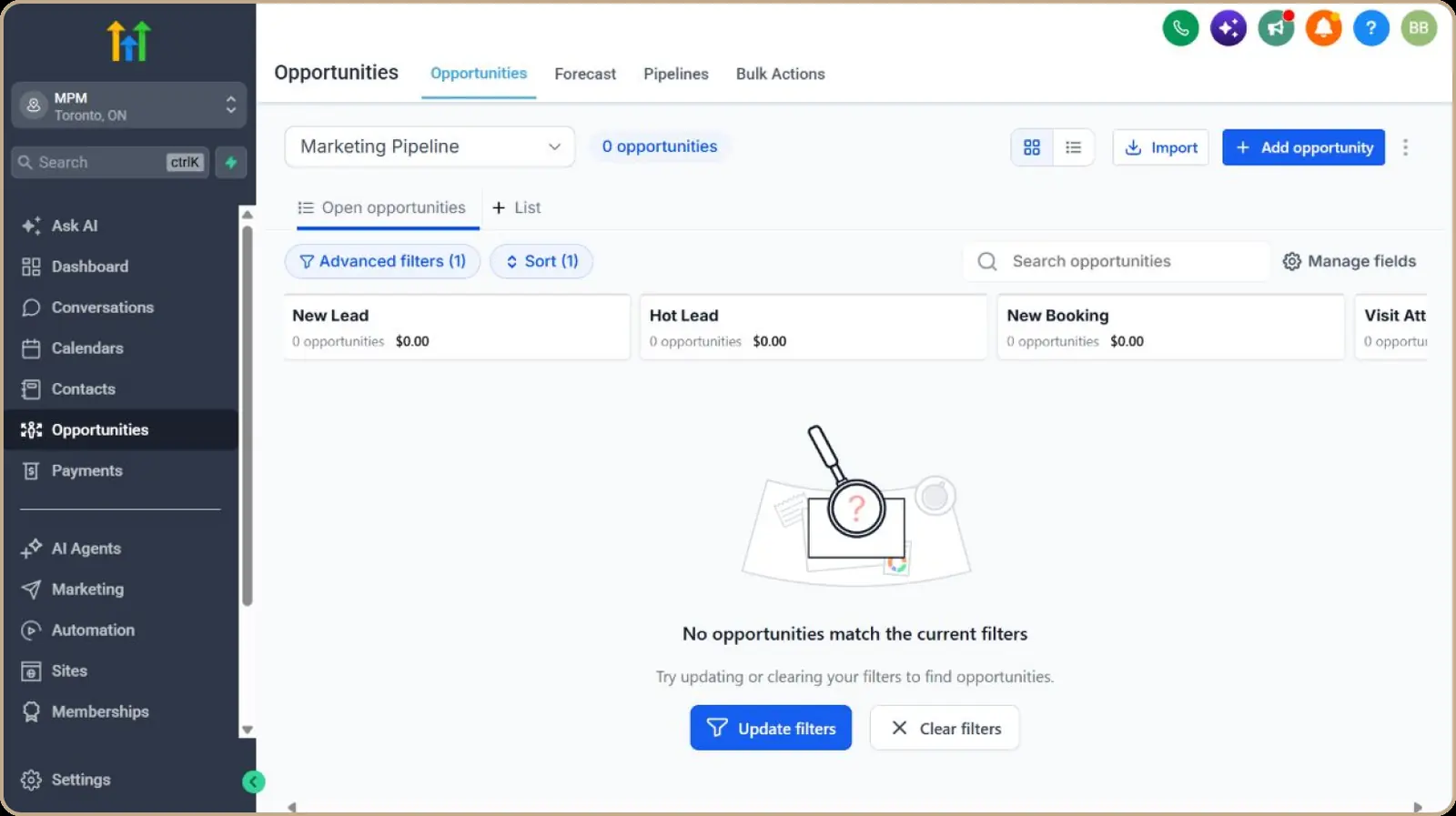
Surfaces enquiries that still need an owner or a next action. An enquiry becoming a CRM record isn't enough — the system creates visible internal work so somebody actually owns the next step.

Separates preparing a quote from approving it. The owner reviews the exact snapshot — recipient, scope, price, presentation — and approval is bound to that version's hash. Change anything, and a new version needs fresh approval.
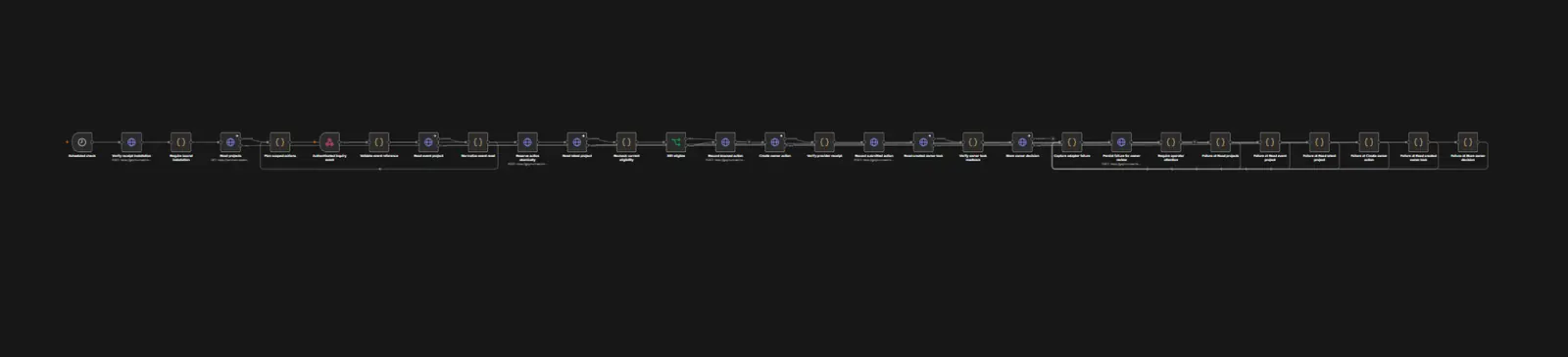
Keeps the correct appointment connected to the correct job. Rescheduling can't let an old cancellation kill the replacement booking, and elapsed calendar time is never treated as proof anyone attended.
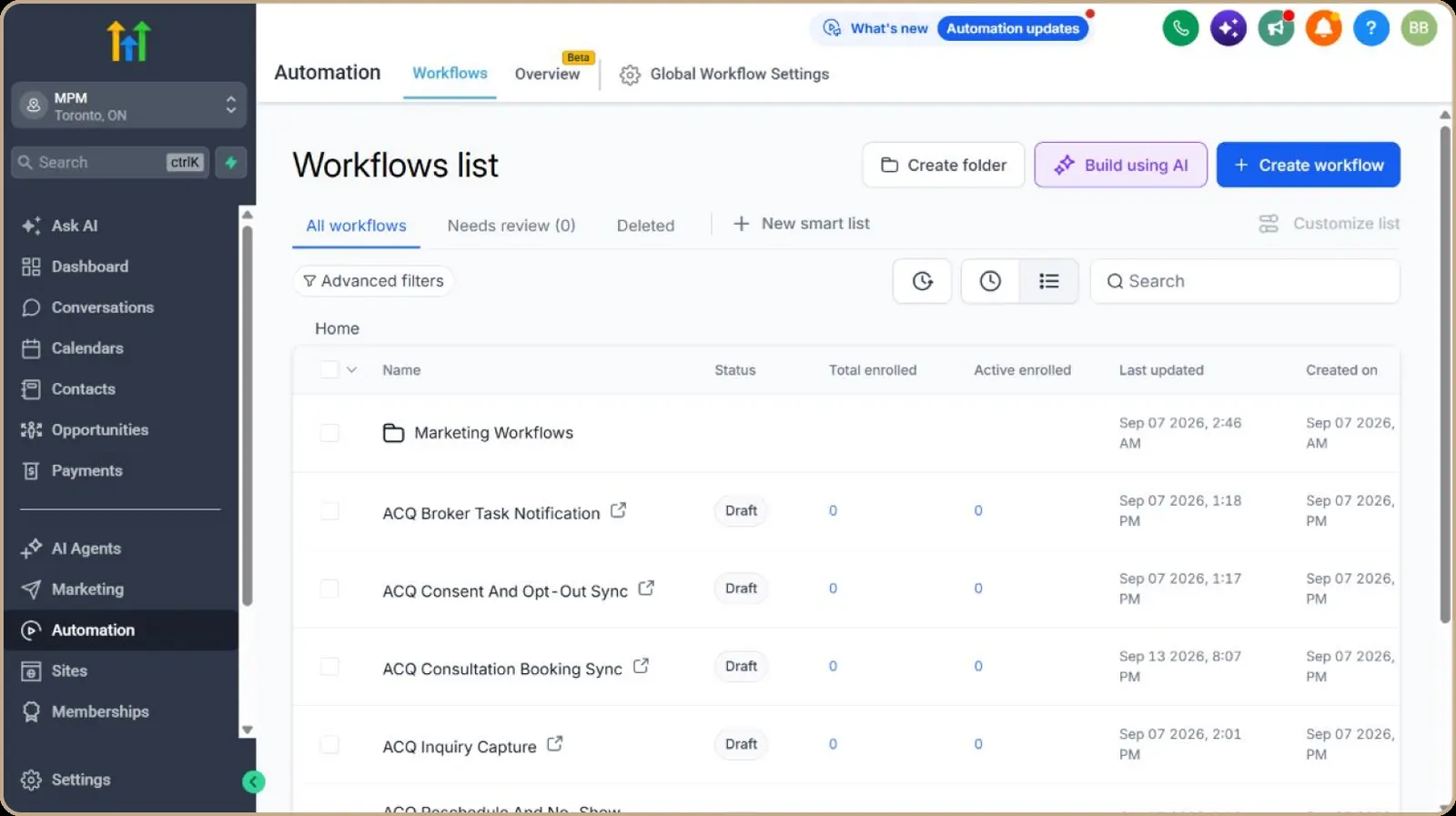
Follows up only when the quote is current, eligible, and permitted. Reply, opt-out, stage-change, and quote-version guards are rechecked at action time — a scheduled send is never entitlement to ignore new stop evidence.
A focused queue of recoverable work, every weekday morning. It surfaces opportunities with a useful next action — it doesn't invent discounts, loss reasons, or recovered sales.
Quote, version, recipient, amount — Approve / Reject. Laneo manages the workflow around the quote; the contractor controls scope, pricing, and commercial approval. The review control reads the stored snapshot, and the decision receipt records actor, session, staff mapping, project, exact quote hash, and server timestamp.
And every weekday, the owner gets the Revenue Recovery List — every open opportunity with a useful next action, in one view.
| Stage | Focus | Key results |
|---|---|---|
| Stage 1 | Diagnose | Revenue Diagnosis first: demand gap, capture gap, follow-through gap — or a process that's already sufficient, in which case there's no sale. |
| Stage 2 | Configure | Accounts and access collected, client manifest completed, system installed inactive. Existing calendars and tools preserved — recorded as reuse, integrate, or disable, never silently replaced. |
| Stage 3 | Accept | Builder acceptance tests, then Review Mode before controlled activation. Authority and copy reviewed before anything customer-facing goes live. |
| Stage 4 | Measure | Honest baselines captured, then Day-30/60/90 evidence snapshots. Verified, unknown, or not available — missing data never becomes zero. |
| Action | System authority | Human requirement |
|---|---|---|
| Internal owner tasks | Automatic (if enabled) | Verified assignment; staff acts on the task |
| Quote scope & price | None | Owner supplies the commercial proposal |
| Quote delivery | Disabled / approval-gated | Exact-version approval + accepted send path |
| Customer follow-up | Disabled / approval-gated | Eligible quote; all stop checks pass at action time |
| Won / Lost / Paused | None | Human terminal decision with evidence |
| Emergency enquiries | Internal routing only | Explicit human owner — never auto-dispatch |
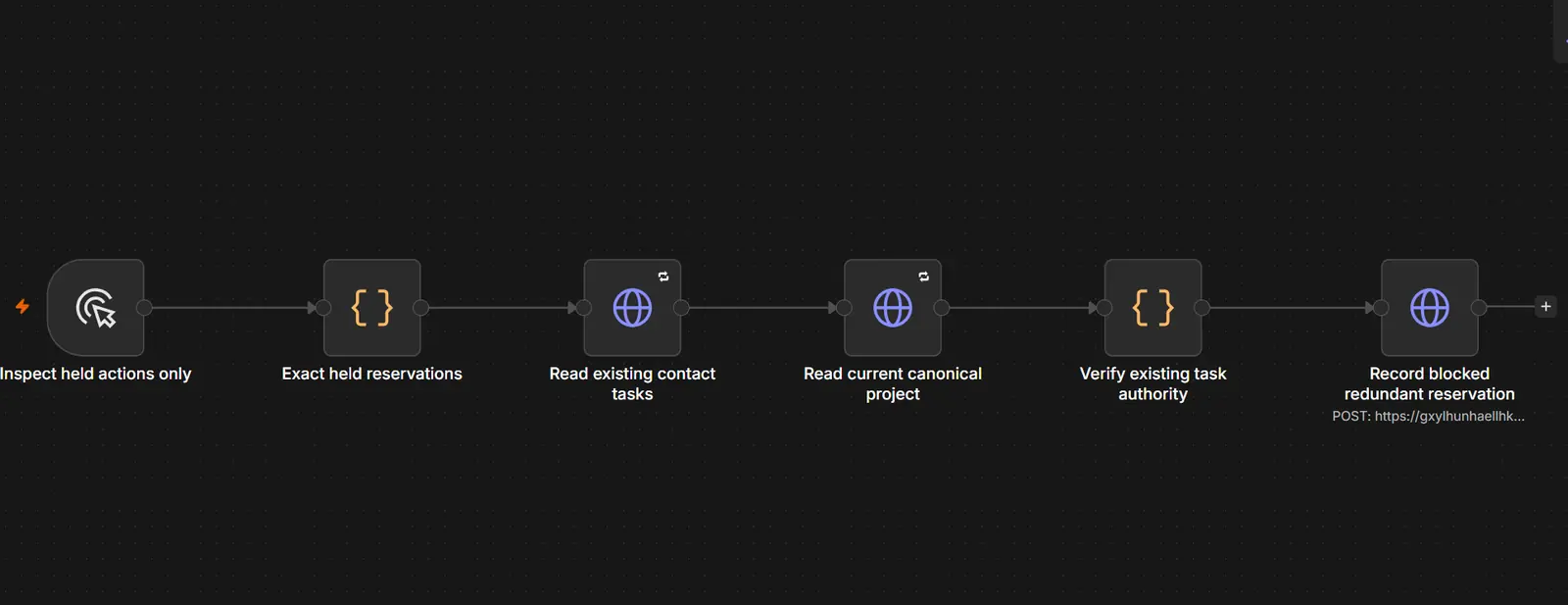
Above: held-reservation inspection — before anything is recorded as blocked, the system re-reads the existing contact tasks and the canonical project and verifies task authority. Redundancy is proven, not assumed.
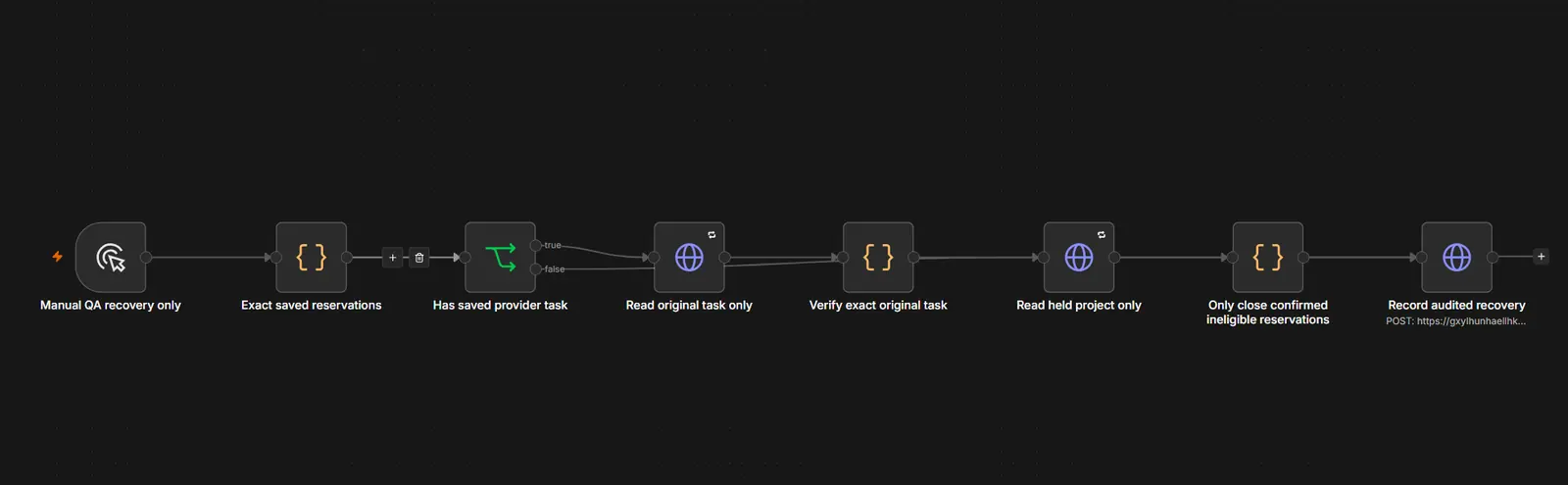
Above: manual QA recovery — only confirmed-ineligible reservations are closed, and every recovery is recorded as an audited event.
A timeout means the provider may have completed the action — missing local confirmation is not proof of failure. The system holds the reservation, inspects provider state, and retains operator review rather than blindly retrying. A controlled retry needs authoritative evidence of absence, not just an empty search result.
Installed around the contractor's existing accounts — not hidden inside a Laneo black box. The client owns their GHL, n8n, Supabase, sender, domain, calendar, and business data.
 HighLevel
 n8n
n8n
 Supabase
When every enquiry is owned work with evidence behind it, the business stops running on memory. The owner can see true capacity before taking on more demand, coach follow-through instead of chasing it, and compare lead sources against verified outcomes instead of gut feel. None of that is a revenue claim — it's what a visible operation allows.
Book a free 20-minute Process Review. We’ll map how your process works today, find the biggest gap, and tell you honestly whether there’s anything worth installing.
Book a Free Process Review →The review is free. Any third-party software or usage costs remain separate.